

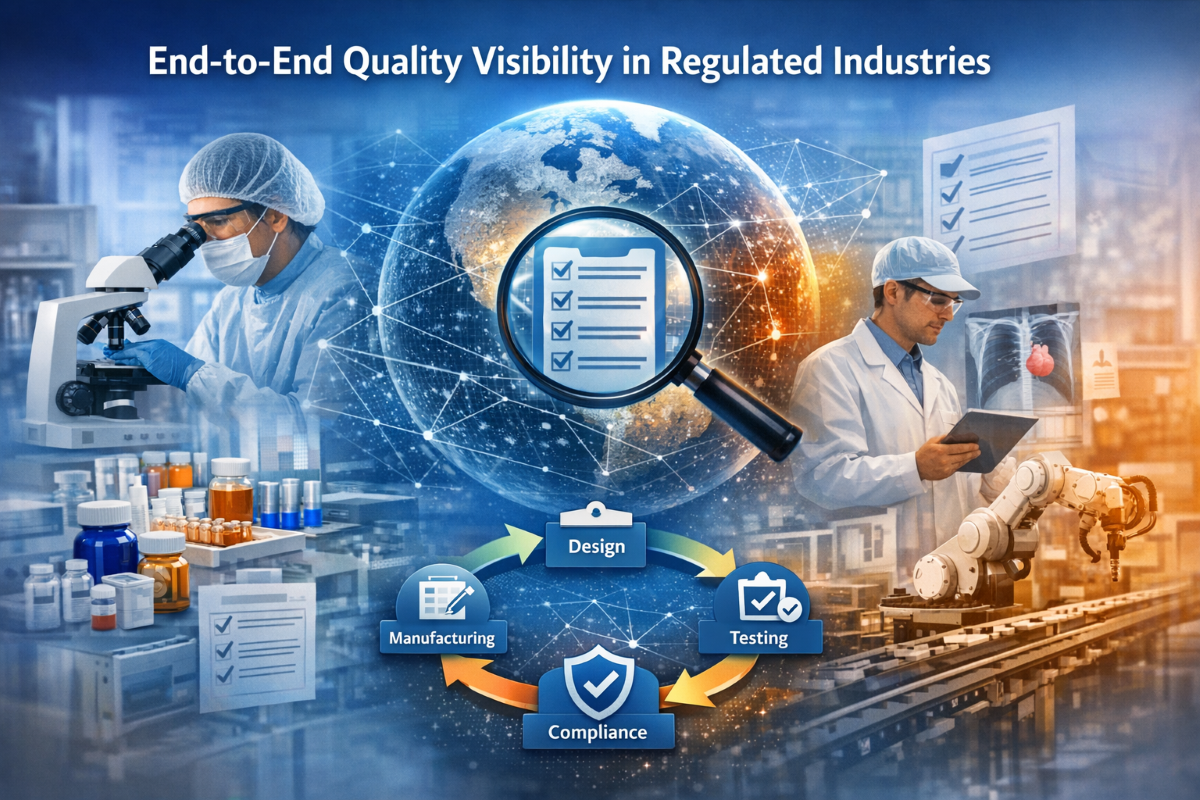
End-to-end quality visibility in regulated industries
- Compliance Quest
- Business
- 2026-02-03 14:15:03
- 2417K
Regulated industries are operating in an environment where complexity is increasing faster than ever. Global supply chains, evolving regulations, accelerated product development cycles, and heightened scrutiny from regulators have made quality management a strategic priority rather than a back-office function. In this landscape, end-to-end quality visibility has emerged as a critical capability for organizations that want to remain compliant, resilient, and competitive.
End-to-end quality visibility refers to the ability to see, track, and manage quality-related data across the entire product lifecycle—from supplier qualification and design controls to manufacturing, post-market surveillance, and continuous improvement. For regulated industries such as pharmaceuticals and medical devices, this level of transparency is no longer optional.
Why quality visibility matters more than ever
Historically, many organizations managed quality through disconnected systems, spreadsheets, and manual workflows. While this approach may have worked in the past, it struggles to keep pace with today’s regulatory and operational demands.
Several factors are driving the growing importance of end-to-end quality visibility:
- Regulatory expectations are expanding, with authorities demanding greater traceability, real-time reporting, and documented evidence across the lifecycle
- Products are becoming more complex, increasing the risk of quality issues if data is siloed
- Global operations require consistent quality standards across sites, partners, and regions
- Market pressure demands faster innovation without compromising safety or compliance
Without a unified view of quality, organizations often operate reactively—addressing issues after they escalate rather than preventing them in the first place.
The role of a connected Quality Management System
At the center of end-to-end quality visibility is a robust Quality Management System that connects people, processes, and data. Instead of treating quality as a series of isolated activities, modern systems enable organizations to manage quality as an integrated, continuous process.
A connected approach allows quality leaders to:
- Identify risks early by analyzing trends across deviations, complaints, and audits
- Maintain full traceability between requirements, controls, actions, and outcomes
- Improve decision-making with real-time insights rather than lagging reports
- Demonstrate compliance confidently during inspections and audits
When quality data flows seamlessly across functions, organizations gain the clarity needed to move from compliance-driven execution to proactive quality leadership.
Quality visibility in medical device manufacturing
Medical device manufacturers face stringent regulatory requirements, including design controls, risk management, and post-market surveillance. A Medical device QMS must support end-to-end traceability, linking design inputs and outputs with verification, validation, and risk controls.
End-to-end quality visibility enables device manufacturers to:
- Track design changes and their impact on risk and compliance
- Monitor nonconformances and CAPAs across manufacturing sites
- Connect complaint handling and vigilance data back to design and production processes
- Ensure alignment with standards such as ISO 13485 and global regulatory frameworks
By breaking down silos between R&D, quality, and manufacturing, organizations can reduce the likelihood of recalls, inspection findings, and delayed approvals.
Strengthening compliance in pharmaceutical operations
Pharmaceutical organizations operate under constant regulatory oversight, where data integrity, process control, and documentation accuracy are critical. A Pharmaceutical QMS supports compliance with GMP requirements while enabling greater operational visibility.
With end-to-end quality visibility, pharma companies can:
- Gain real-time insights into deviations, investigations, and corrective actions
- Ensure consistent quality processes across global manufacturing networks
- Improve audit readiness with centralized documentation and traceability
- Support continuous improvement initiatives driven by quality metrics and trends
Rather than responding to quality issues after they impact production or supply, organizations can identify signals early and take preventive action.
The shift toward digital and intelligent quality platforms
As regulatory expectations grow, organizations are increasingly turning to modern QMS Software to replace legacy systems. Digital platforms provide the foundation for end-to-end quality visibility by integrating quality processes into a single, unified environment.
Key capabilities that support visibility include:
- Centralized data management for audits, CAPAs, documents, training, and risk
- Automated workflows that reduce manual errors and improve consistency
- Advanced analytics that surface trends and potential risks
- Scalable architectures that support growth and global operations
By leveraging intelligent quality platforms, organizations can align quality objectives with business goals, turning compliance into a competitive advantage.
Business benefits beyond compliance
While regulatory compliance is a primary driver, end-to-end quality visibility delivers value well beyond meeting requirements. Organizations that invest in connected quality systems often see measurable business benefits, including:
- Reduced cost of poor quality through earlier detection and prevention
- Faster time to market with fewer rework cycles and delays
- Improved supplier performance through transparent quality metrics
- Stronger cross-functional collaboration and accountability
Quality becomes a shared responsibility across the organization, supported by data rather than assumptions.
Building a culture of proactive quality
Technology alone is not enough. End-to-end quality visibility also supports a cultural shift toward proactive quality management. When teams have access to reliable, real-time information, they are empowered to make better decisions and take ownership of quality outcomes.
This visibility fosters:
- Greater confidence in regulatory interactions
- Continuous learning through trend analysis and root cause insights
- Alignment between leadership, operations, and quality teams
Over time, quality evolves from a compliance function into a strategic enabler of growth and innovation.
Looking ahead
As regulated industries continue to evolve, the demand for transparency, traceability, and agility will only increase. Organizations that embrace end-to-end quality visibility will be better positioned to manage risk, adapt to change, and deliver safe, compliant products to market.
Modern quality management is no longer about checking boxes—it is about creating a connected ecosystem where quality data drives smarter decisions at every stage of the lifecycle.
Solutions like ComplianceQuest help regulated organizations achieve this vision by delivering a unified, Salesforce-native platform that supports end-to-end quality visibility, scalability, and continuous improvement—enabling quality leaders to move from reactive compliance to proactive excellence.
2417 people like this


About Premium Author
This post has been authored and published by one of our premium contributors, who are experts in their fields. They bring high-quality, well-researched content that adds significant value to our platform.
Leave a Reply
Please login to post a comment.





0 Comments