

How Faded and Non-Compliant Line Marking Is Creating Liability Issues for Melbourne Businesses
- Western Suburbs Line Marking
- Business
- 2026-07-22 15:06:49
- 2689K
Faded and non-compliant line marking can do more than make a site look neglected. For Melbourne businesses, it can increase the risk of trips, vehicle collisions, workflow confusion, and safety breaches that may lead to liability concerns. Clear, compliant markings are not just a visual detail; they are part of how a site communicates safety and direction.
Why line marking matters
Line marking helps people understand where to walk, where to drive, where to store goods, and where hazards may exist. In busy commercial spaces, even a small amount of fading can make those instructions harder to read. That creates uncertainty, and uncertainty is often where incidents begin.
For businesses that manage warehouses, loading areas, car parks, or pedestrian zones, line marking plays a practical role in keeping movement organised. When markings are too worn to be effective, staff and visitors may not recognise boundaries, turn paths, or no-go zones in time. That can affect both safety and efficiency.
How liability risks develop
Liability issues often arise when a business fails to maintain a safe environment. If line marking has faded to the point where it no longer clearly shows traffic flow or pedestrian access, an incident can be harder to defend. In a dispute, questions may be raised about whether the business took reasonable steps to maintain the site.
This matters because line marking is part of a broader duty of care. If a pedestrian steps into a vehicle lane, or a forklift operator misreads an access route, the condition of the markings may become relevant to how the incident occurred. Poor visibility can contribute to confusion, and confusion can contribute to harm.
Common problem areas
Some areas of a site wear down faster than others. High-traffic zones, turning points, loading bays, and entry routes often lose visibility sooner because they are exposed to constant movement and friction. Outdoor areas may also fade faster because of sun, weather, and surface wear.
Car parks can be especially vulnerable. Bay lines, directional arrows, disabled spaces, and pedestrian crossing indicators all need to remain clear. If they are faded or patchy, the site can become harder to navigate, and that may create avoidable risk for drivers and pedestrians.
Non-compliance concerns
Non-compliance does not always mean the markings were never installed correctly. It can also mean they are no longer clear enough to serve their intended purpose. In that sense, faded markings can be just as problematic as missing ones.
Where a business relies on line marking to support site safety, maintenance needs to be ongoing rather than one-time. If markings are not kept visible and functional, the site may no longer meet the standard expected for safe operation. That is why regular inspections are just as important as the initial installation.
Warehouses and operational safety
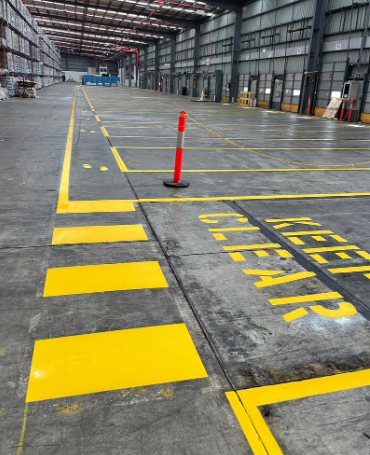
Warehouses face some of the highest risks because vehicles, staff, stock, and equipment often move through the same space. A small marking failure in a warehouse can create a much larger operational issue than it would in a quieter environment. Forklift lanes, exclusion zones, loading paths, and pedestrian corridors all need to be easy to identify at a glance.
This is where proper planning makes a difference. A well-marked warehouse reduces hesitation and helps workers follow the correct path without stopping to guess. For businesses looking at Warehouse Line Marking in Melbourne, the goal should be to make the site easier to understand and safer to use every day.
The role of maintenance
Line marking should be checked regularly, not only after an incident occurs. Once the surface starts to fade, the markings are already losing value. Businesses that wait too long often face higher costs later, both in repair work and in the operational problems caused by unclear site traffic.
A maintenance schedule helps identify early wear before it becomes a safety issue. Repainting or refreshing lines at the right time keeps the site presentable and functional. It also shows that the business is taking practical steps to maintain safety standards.
Why local expertise matters
Different sites have different demands, and a one-size-fits-all approach does not always work. A warehouse, retail car park, logistics yard, and industrial facility all require markings that suit their layout and traffic flow. That is why working with experienced Melbourne Line Markers can help businesses choose solutions that match the way the site is actually used.
Local knowledge can also matter when planning around Australian conditions and business expectations. The right approach considers surface type, traffic load, and the need for visibility over time. Businesses that take this seriously are more likely to reduce confusion and protect their site users.
Reducing risk before it becomes a problem
The best time to deal with line marking is before a claim, complaint, or incident occurs. Faded lines may seem minor, but they can create practical safety gaps that become costly later. Clear markings improve movement, support site organisation, and help show that the business is actively managing risk.
For Melbourne businesses, keeping line marking compliant and visible is a straightforward way to strengthen safety and reduce liability exposure. It is a small maintenance task with a meaningful impact on how a site functions. Western Suburbs Line Marking can help businesses address these issues with a more reliable and professional approach to site marking.
2689 people like this



About Premium Author
This post has been authored and published by one of our premium contributors, who are experts in their fields. They bring high-quality, well-researched content that adds significant value to our platform.
Leave a Reply
Please login to post a comment.







0 Comments