

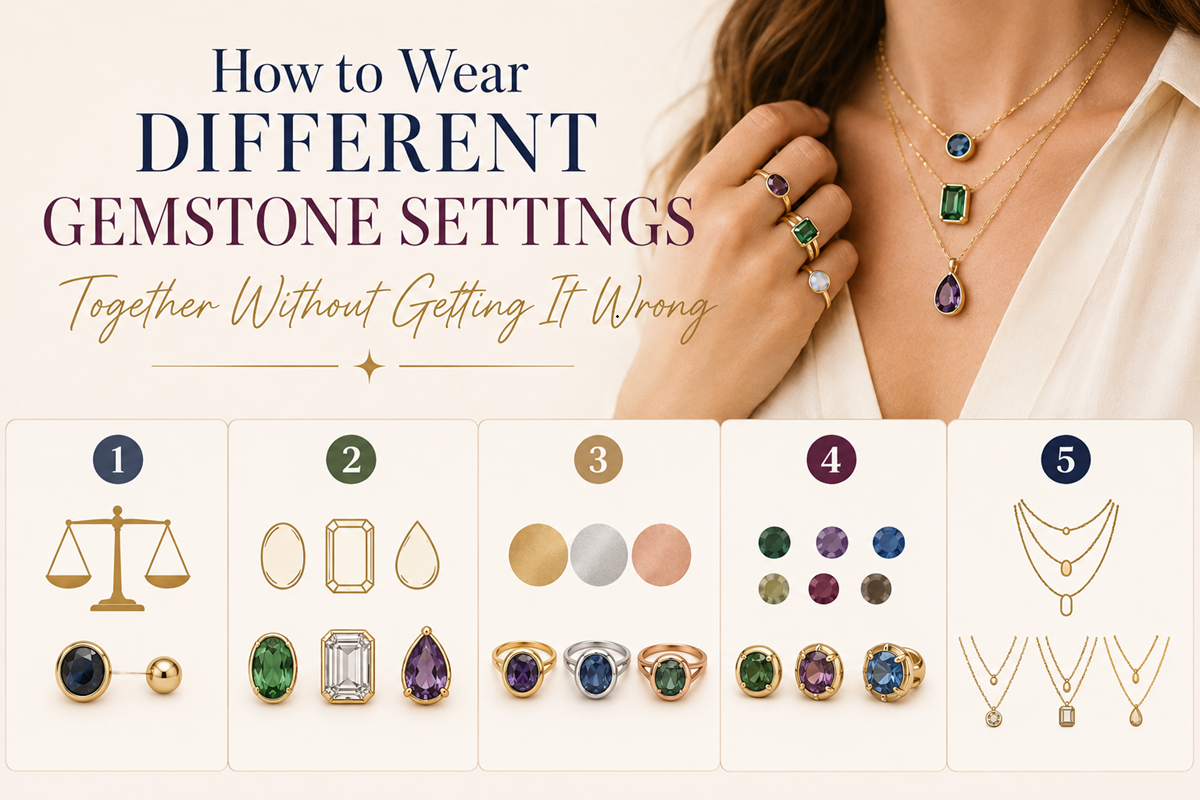
How to Wear Different Gemstone Settings Together Without Getting It Wrong
- Karob Jewels
- Fashion
- 2026-08-19 14:11:59
- 2797K
There’s a particular kind of jewellery mistake that nobody warns you about until you’re standing in front of a mirror, wondering why two beautiful pieces worn together somehow look wrong. It’s rarely about quality but almost always about a combination, which means mixing a stone, a setting, or a metal tone that technically “matches” but doesn’t actually work together.
Pairing rings and earrings well is a genuinely underrated skill, and coloured gemstones make the stakes higher than with plain diamonds. If you’re searching for the ideal guide to pairing earrings and rings, this article is perfect for you. Let’s go over the details and explore how to pair them without getting them wrong.
Why Earring and Ring Pairing Is Harder Than It Looks
Rings and earrings sit at entirely different distances from the eye. A ring is seen up close, in detail, usually against skin and sometimes against a wedding band. Earrings are seen from a distance, framed by hair and face, catching light differently depending on movement. That distance difference is precisely why a pairing that looks perfect side by side on a jewellery tray can look mismatched the moment it’s actually worn.
The Two Safe Strategies
There are really only two combinations that reliably work, and almost everything else is a variation on one of them:
- Matching the gemstone family: This creates a cohesive, intentional look that reads as a considered choice rather than a coincidence.
- Letting one piece carry the colour: This approach avoids competing focal points and allows each piece to be seen.
What doesn’t tend to work is two different coloured stones fighting for attention at entirely different points on the body, unless there’s a genuinely deliberate design reason tying them together.
Blue Sapphire Earrings

Blue sapphire earrings earn their popularity honestly, which means sapphire’s deep, saturated blue reads as both classic and current, and it plays well with almost every metal tone and skin tone going.
Pairing Blue Sapphire Earrings with a Ring
If you already own a blue sapphire ring, matching it with the same gemstone earrings is close to a guaranteed win, as the two pieces read as a set even if they were bought separately, years apart. Where it gets more intriguing is pairing blue sapphire-coloured earrings with a ring in a different stone entirely. Tanzanite, with its own blue-violet undertone, actually complements sapphire reasonably well since the two sit close enough on the colour spectrum to feel related rather than clashing. However, it’s worth trying this combination in person since tanzanite’s colour shift under different lighting can either harmonise beautifully with sapphire or occasionally pull toward violet in a way that feels slightly at odds with sapphire’s steadier blue.
Metal Tone Matters as Much as Stone Colour
White metals tend to be the safest choice when pairing blue sapphire pieces together, as the cool tone doesn’t compete with the stone’s own cool blue. Mixing a yellow gold ring with a white gold pair of earrings isn’t a hard rule-break, but it does add a second variable to manage, and for a first attempt at combining pieces, keeping metal tone consistent removes one layer of risk.
Tanzanite Earrings
Tanzanite is one of the more distinctive coloured stones available, largely because of its pleochroism, which is the way it shifts between blue, violet, and occasionally a burgundy undertone, depending on the angle from which it’s viewed. That quality makes tanzanite earrings in the UK, genuinely striking on their own, but it also means pairing them takes slightly more thought than a colour-stable stone like sapphire.
Why Tanzanite Earrings Deserve Their Own Ring, Not Just Any Ring
Because tanzanite’s colour shifts with light and angle, pairing it with a ring in an entirely different coloured stone can create an odd visual conversation where two different colours, each already changing depending on where you’re standing, interact. The more reliable approach is either matching tanzanite with tanzanite or pairing tanzanite earrings in the UK with a diamond or plain metal ring that doesn’t compete for colour. That second option is often underrated: letting tanzanite’s shifting blue-violet be the only coloured element in an outfit tends to showcase it far better than sharing the spotlight with another gemstone.
Lab Grown Tanzanite as a Practical Option
For anyone building a matching set gradually rather than buying both pieces at once, lab grown tanzanite is worth knowing about, as it is chemically and optically identical to mined stones but offers more flexibility on size and budget when building out a ring to match earrings bought earlier, or the reverse.
Halo Earrings

A halo setting does one thing very effectively: it makes the centre stone look larger and catches considerably more light than a plain solitaire setting. Halo earrings use exactly the same principle, which is precisely why they need to be paired thoughtfully rather than automatically.
Matching Halo Scale, Not Just Halo Presence
The most common mistake with halo pairings isn’t choosing the wrong stone, but it’s mismatching the scale of the halo itself. A ring with a large, dramatic halo paired with earrings carrying a much smaller, subtler halo can end up looking like two different jewellery decisions rather than one coordinated look. The fix is straightforward once you know to look for it: check that the halo’s visual weight feels proportionate between the ring and the earrings, not just that both technically have a halo.
Summing Up
To sum up, when planning to invest in jewellery options, particularly gemstones, there are several important factors to consider. Always ensure that the ring and the earrings you are investing in complement each other as two individually beautiful rings and earrings may not necessarily look beautiful together.
2797 people like this



About Premium Author
This post has been authored and published by one of our premium contributors, who are experts in their fields. They bring high-quality, well-researched content that adds significant value to our platform.
Leave a Reply
Please login to post a comment.








0 Comments